The Holomind Manifesto
The Holomind Manifesto: Reclaiming Humanity in the Age of Shared Realities
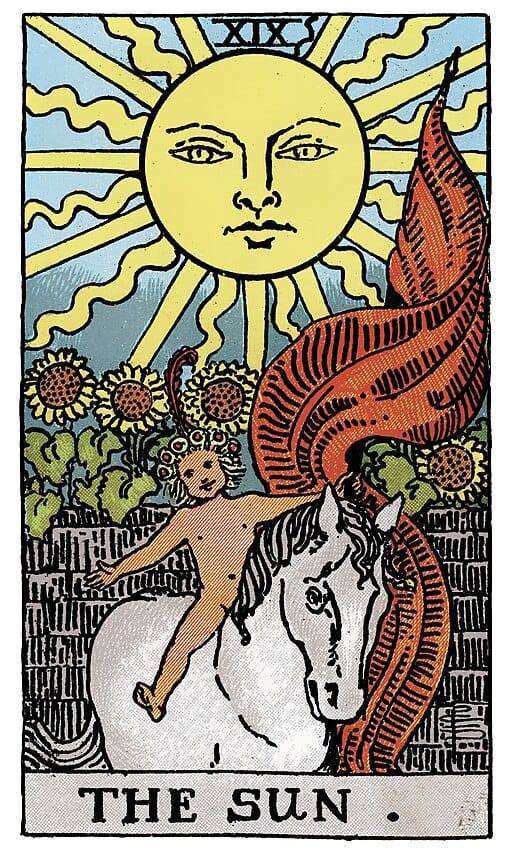
This manifesto looks to The Sun of the Tarot as its north star – not the end of the Fool’s journey, but the moment we step out of the shadows and see the world with new eyes. It sketches a shift from technology as distraction to technology as critical infrastructure for trust, empathy, and our shared survival – compressing what Rutger Bregman showed is possible in small groups into a faster, gentler practice of intercultural encounter through “magical goggles”, also known as VR headsets.
It rests on the convergence of social VR, compassionate AGI, and old‑new wisdom traditions to propose a fresh way of being “in‑person” across any distance – small group by small group, up to five people at a time, so every voice is heard and the conversation actually flows.
The Fool’s Journey: A Manifesto for the World We Walk
We begin with The Fool – a curious human standing on the cliff‑edge of a burning planet, a VR headset in hand and a small bundle of stories on their back. They sense that the old ways of shouting across glowing rectangles are not enough, yet they do not know what might replace them. They simply take a step.
1. Meeting the Magician and High Priestess – Discovering Tools and Depth
The Fool first encounters The Magician, who shows that technology is not sorcery but a set of tools – headsets, networks, code – that can channel attention and presence if we use them with intent rather than habit.
Then comes The High Priestess, reminding the Fool that no amount of hardware matters without inner work – curiosity, listening, and a willingness to sit with the unknown in oneself and in others.
2. Empress, Emperor, Hierophant – Learning Culture, Power, and Story
With The Empress, the Fool discovers the sheer richness of human culture – food, art, pottery, language – and realises VR could carry these living textures across oceans, not just flat images.
The Emperor teaches that structures and rules will always exist; the question is whether we build fortresses of control or frameworks that keep small groups safe enough to be honest.
Through The Hierophant, the Fool sees how inherited dogmas and “sacred” stories can both guide and divide us, and understands that the holoweb must welcome many traditions without letting any one of them dominate.
3. Lovers, Chariot, Strength – Choosing Companions and Courage
In The Lovers, the Fool discovers that this journey cannot be walked alone; the real magic happens when people from different cultures and histories sit together and speak plainly about what hurts and what matters.
Riding The Chariot, they feel the wild rush of new technology and global ambition – the temptation to scale, optimise, conquer – and sense how easily this can flatten human souls.
Strength appears not as brute force but as gentle persistence: the courage to keep opening a small circle of up to five people, again and again, even when the world screams for spectacle instead.
4. The Hermit and Wheel of Fortune – Stepping Back, Seeing Patterns
As The Hermit, the Fool withdraws from the noise to sit alone with uncomfortable questions: Why are we so divided? Why does technology so often isolate instead of connect?
The Wheel of Fortune turns, showing how empires, platforms, and trends rise and fall; the Fool realises that no single company or nation will save us – our hope lies in many small, resilient circles linked together.
5. Justice, Hanged Man, Death – Facing Consequences and Letting Go
Justice asks the Fool to look squarely at consequences: climate breakdown, nuclear risk, runaway AI, and the quiet loneliness of millions scrolling in the dark. The question becomes: “What would be fair to future generations?”
With The Hanged Man, everything inverts; the Fool sees that the problem is not distance but the way we meet. If we change the frame – from broadcast to small, embodied conversation – the whole picture shifts.
Then comes Death – not annihilation, but the shedding of old habits: doom‑scrolling, partisan outrage, techno‑cynicism. The Fool lets these die to make room for a different way of being online and together.
6. Temperance, Devil, Tower – Testing the Vision
Temperance teaches the mixing of worlds: physical and virtual, local and global, Zen simplicity and advanced tech. The Fool learns to treat VR not as escape, but as a carefully measured extension of embodied life.
In The Devil, they confront the shadow side of the net: addiction, manipulation, the reduction of people to data points. The holomind, they decide, must never be another machine for harvesting attention.
Inevitably, The Tower falls – institutions, platforms, and stories that once felt solid crumble. This shock convinces the Fool that we cannot patch the old world; we must grow a new one in parallel, from the bottom up.
7. Star, Moon, Sun – Hope, Confusion, Enlightened Presence
After the ruins, The Star appears: small lights of hope. The Fool sees experiments in social VR, citizen assemblies, tiny communities where trust still exists, and understands that “another internet” is already quietly being born.
Under The Moon, fears and illusions surface – What if this is all wishful thinking? What if people will always prefer shouting to listening? The Fool walks through uncertainty, guided only by intuition and the faint glimmer of shared humanity.
Then, at last, The Sun rises. Here the Fool discovers that enlightenment is not thunder and lightning, but the simple joy of five people standing together in a virtual garden, feeling unafraid and fully present with one another. The Sun shows that intercultural, small‑group conversation can change how we see the entire world – and that VR can compress the distance between us into a single step.
From this point on, The Sun becomes the north star of the holomind: a promise that our tools can help us step out of the fortress and into shared light.
8. Judgement – The Call to Build the Holoweb
With Judgement, a trumpet sounds. The Fool realises this journey is no longer private therapy; it is a summons. If we can meet across borders as embodied, vulnerable humans – if we can build trust before we build machine gods – then we have a duty to do so.
Judgement, in this manifesto, is the invitation to join or found a holomind: a small circle where people walk, talk, and think together in VR as if the future depended on it – because it does.
9. The World – The Shared Reality We Want to Create
Finally, the Fool steps into The World. This is not a single utopian city in the sky, but a living network of many small Worlds: countless circles of five, linked into a holoweb that spans cultures, languages, and histories.
In The World, difference is not erased; it is held in a larger whole. People carry their local stories – their wagtails, their kilns, their wars, their songs – into shared spaces where they can be seen, heard, and transformed. VR becomes ordinary infrastructure for empathy, as natural as a phone line once was.
The World is the state in which technology, Tarot, and Zen all agree: everything belongs, everything is connected, and the work now is to give back what we have learned. Having walked the circle from Fool to World, we become Fools again – stepping off a new cliff, into a new cycle – each time a little wiser, a little more open, and a little more ready to walk this web together.